







- Home
- Call for Papers
- Program Committee
- Registration
- Accepted Papers
- Author Information
- Technical Program
- Invited Speakers
- Conference Venue
- Explore Perth
- Photos
- Sponsors
- Contact Us






ACISP 2026
Keynote Speakers

Vinod Vaikuntanathan
Massachusetts Institute of Technology
Cryptographic Thinking for AI
Tuesday 7 July, 9.00am - 10.00am
Abstract: We will explore the emerging role of cryptographic thinking, modeling, and techniques in addressing core challenges in trustworthy AI, using examples from backdoors, alignment, watermarking, and applications of cryptography to non-cryptographic goals.
Bio: Vinod Vaikuntanathan is the Ford Foundation Professor of Engineering in the EECS Department at MIT, a principal investigator at MIT CSAIL, and the chief cryptographer at Duality Technologies. He earned his BTech degree from the Indian Institute of Technology Madras in 2003, and his SM and PhD degrees from MIT in 2005 and 2009, respectively. After a postdoctoral stint at IBM Research, a year as a researcher at Microsoft, and two years as a faculty member at the University of Toronto, Vinod joined the faculty of MIT EECS in September 2013.
Vinod's research is on the foundations of cryptography and its applications to theoretical computer science at large. He is known for his work on fully homomorphic encryption, a powerful cryptographic primitive that enables complex computations on encrypted data, as well as lattice-based cryptography, which provides a new mathematical foundation for cryptography in the post-quantum world. More recently, he has been interested in the interactions of cryptography with quantum computing, as well as with statistics and machine learning.
Vinod's work has been recognized with the Harold E. Edgerton Faculty Award (2018), the Godel Prize (2022), the Simons Investigator Award (2023), the Distinguished Alumnus Award from IIT Madras (2024), a Best Paper Award from CRYPTO 2024, and test-of-time awards from IEEE FOCS and CRYPTO conferences. He was also named a MacVicar Faculty Fellow in 2024 for exceptional teaching and mentoring.
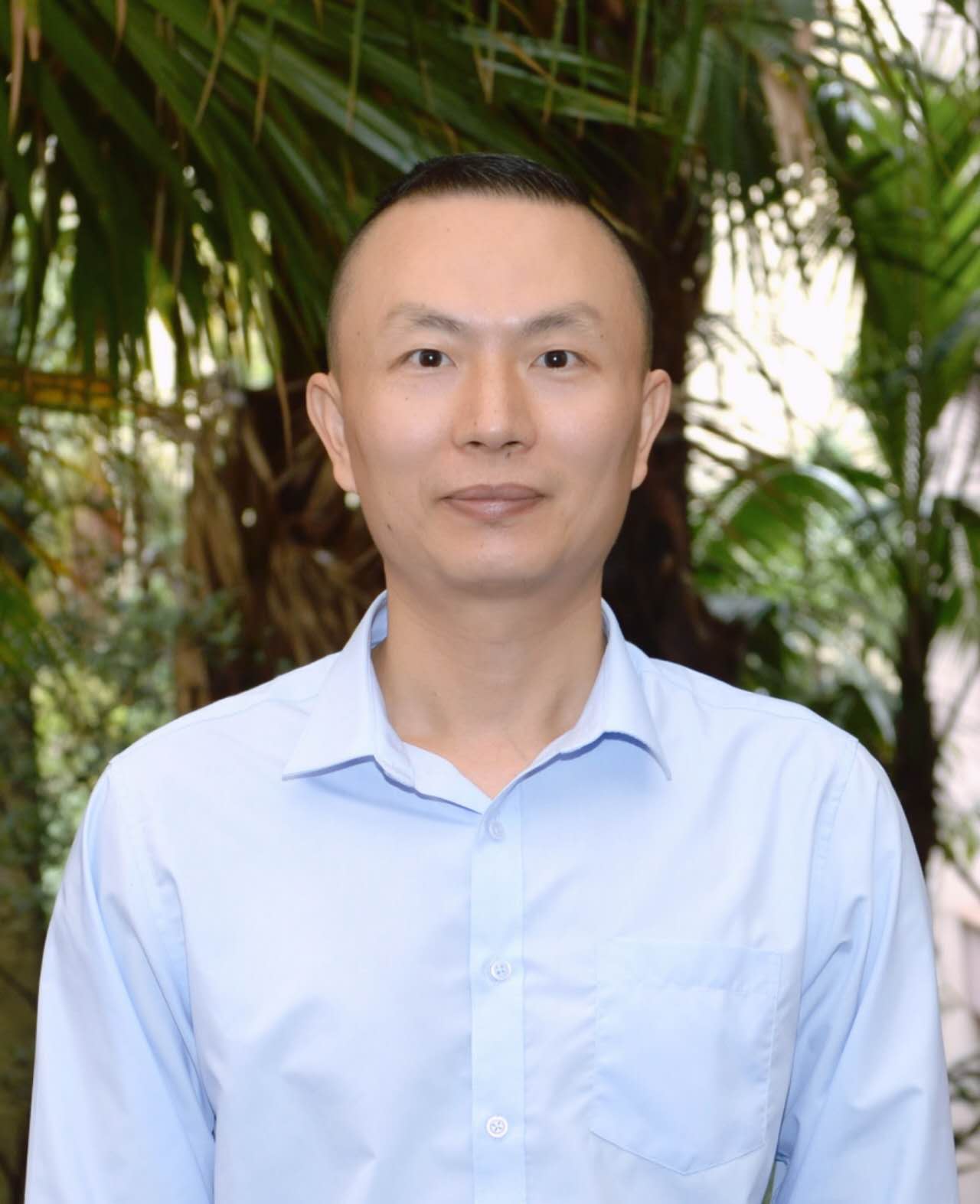
Fuchun Guo
University of Wollongong
Public-Key Cryptography Over the Past Five Years: Structure, Survey, and Story
Wednesday 8 July, 9.00am - 10.00am
Abstract: Over the past five years, public-key cryptography has witnessed rapid progress. A large number of new constructions have emerged, driven by applications such as quantum computing, blockchain systems, cloud computing, and privacy-preserving computation. While this body of work is rich and diverse, it also raises an important question: how should we understand the evolving landscape of public-key cryptography? In this talk, I take a step back to present a structured view of recent developments from 2021 to 2025, based on papers that appeared in Crypto, Eurocrypt, Asiacrypt, and PKC, with a focus on digital signatures and zero-knowledge proof systems. Building on this structure-driven survey, I will share my perspectives on research trends, novelty in research, and the principles underlying the design and understanding of public-key cryptography.
Bio: Dr. Fuchun Guo is an Associate Professor in the School of Computing and Information Technology at the University of Wollongong. He received his PhD from the University of Wollongong in 2013. His research interests include digital signatures and security proofs. He has published three books as a leading author, including Introduction to Security Reduction (2018), Cryptologic Research History of Digital Signatures (2022), and Introduction to Cryptographic Definitions (2025). He received the Australian Research Council's DECRA Fellowship in 2016 and Future Fellowship in 2022. More information is available at: https://www.uow.edu.au/~fuchun/ .

Elisabeth Oswald
University of Birmingham and University of Klagenfurt
Explainable Leakage Assessments
Wednesday 8 July, 12.40pm - 1.40pm
Abstract: The systematic testing for exploitable side-channel leakage is required for increasingly many embedded products due to the demands of certification regimes, such as PSA Certified, EUCC, and FIPS 140-3. Testing methods are either based on specific attacks or on non-specific detection tests. Both approaches come with their unique challenges and rather different cost profiles, with a seemingly unbridgeable gap between them. In this talk, I will discuss some of the methods and highlight the need for interpretability and, even more so, the need for methods that enable us to track down the root cause of information leakage.
Bio: Elisabeth Oswald is a professor at the University of Birmingham in the United Kingdom, as well as the University of Klagenfurt in Austria. Her research focuses on constructive aspects of securely implementing cryptographic algorithms, with a focus on embedded systems. In this context, she has contributed to principled countermeasures, novel attack vectors, and methods to systematically assess information leakage.
She was an EPSRC Leadership Fellow and a recipient of an ERC Consolidator Award. She co-authored a seminal book on power analysis and has won several best paper awards.
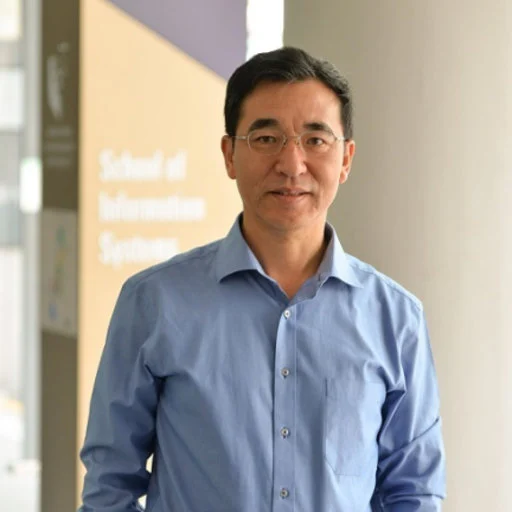
Robert H. Deng
Singapore Management University
Practical Privacy-Enhancing Systems for IoT & 5G
Thursday 9 July, 9.00am - 10.00am
Abstract: Modern digital ecosystems comprise billions of interconnected devices such as smartphones, IoT, and 5G systems that continuously generate sensitive data, including location, behavior, and preferences. Recent large-scale privacy incidents demonstrate that robust privacy protection is essential for security, user trust, and regulatory compliance.
This presentation introduces three of our recent research efforts towards practical privacy-enhancing systems: PriSrv+ for private wireless service discovery, AKMA+ for application authentication and key management in 5G, and keyword-based private information retrieval (PIR). For each system, we discuss the underlying problem, the proposed solution, and their real-world applications. We conclude with future research directions.
Bio: Robert Deng is Lee Kong Chian Chair Professor, Deputy Dean for Faculty & Research, School of Computing and Information Systems, Singapore Management University (SMU). His research interests are in the areas of data security and privacy, network and distributed system security, and applied cryptography. He received the Outstanding University Researcher Award from National University of Singapore, Lee Kuan Yew Fellowship for Research Excellence and Zhongni Distinguished Educator Award from SMU, Asia-Pacific Information Security Leadership Achievements and Community Service Star from International Information Systems Security Certification Consortium (ISC2), and the Public Administration Medal (Silver) Singapore National Day Award. He is a Fellow of IEEE, AAIA, and Academy of Engineering Singapore.
Industry Speakers

Matt Jones
elttam
Offensive Security Considered Offensive
Industry Invited Talk Session: Thursday 9 July, 12.40pm - 1.40pm
Abstract: After two decades inside offensive security, it is worth asking whether the discipline has been moving in the direction it claims to. This talk is a practitioner's retrospective grounded in data from talkback.sh, a platform built at elttam that ingests and analyses security research, advisories, and industry commentary at scale. Using that corpus, the talk traces which work of the past twenty years meaningfully reshaped how systems are built, attacked, and defended, and contrasts it with work that captured attention without producing durable change.
The patterns suggest a field that has grown enormously in volume, funding, and visibility while struggling to convert that growth into proportional defensive outcomes. The talk examines three forces driving that drift: venture capital and the incentives of a fast-scaling commercial sector, the steady militarisation of offensive capability, and the cognitive and social dynamics that steer attention toward what is novel or marketable rather than what is useful. It closes by looking at where the data suggests research would most move outcomes next, including what the rapid maturation of offensive AI may change about the picture.
Bio: Matt Jones has spent over twenty years in cyber security, across offensive work and the engineering of security-critical systems, long enough to watch the field grow from a small technical community into a global industry. He is Director and Co-Founder of elttam, an Australian consultancy focused on deep technical assessment of complex systems, and on building research-driven tooling that supports that work. talkback.sh, the platform whose data underpins this talk, is one part of that effort.
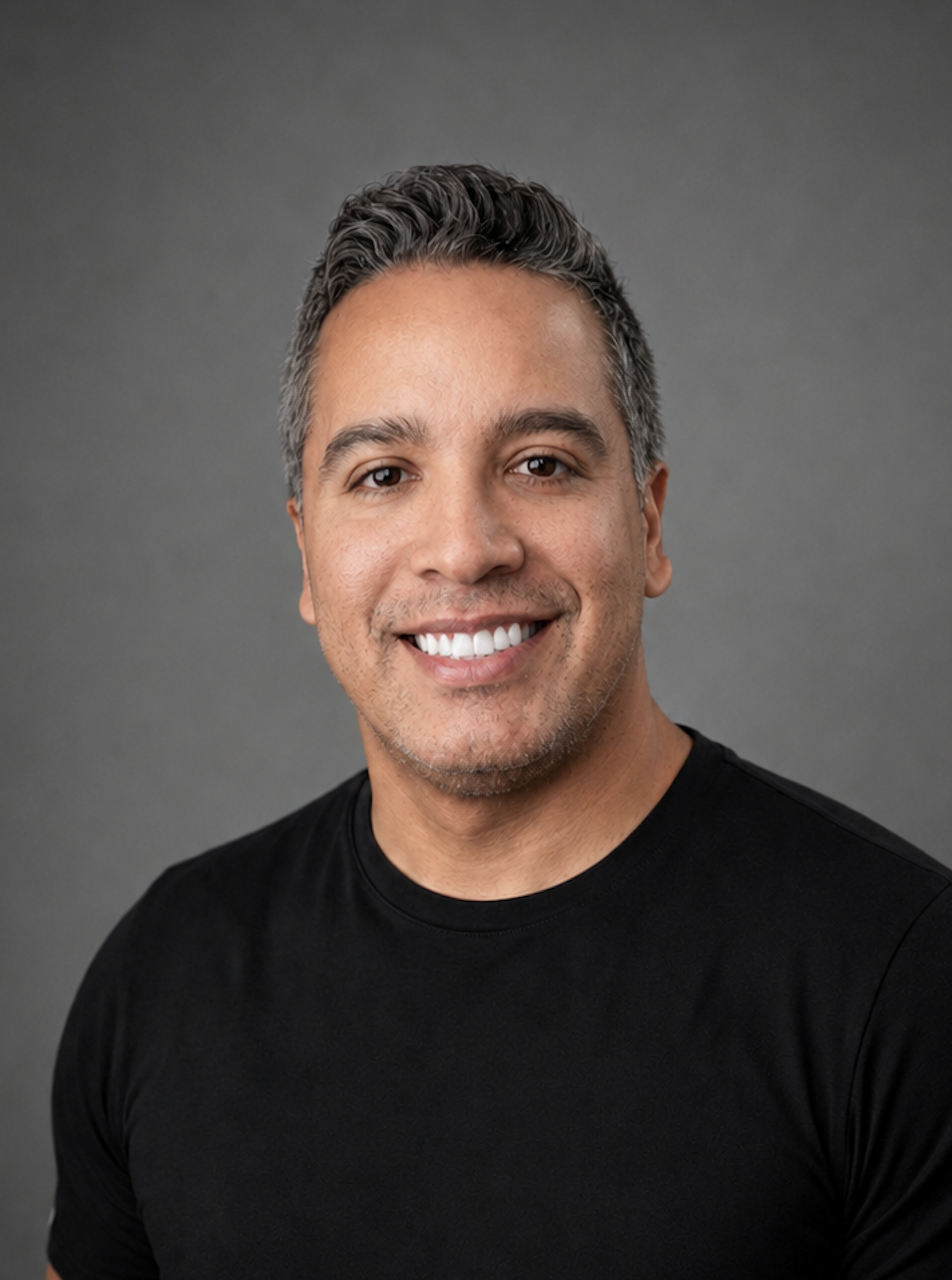
Camilo Pestana
Virtual Gaming Worlds
Curiosity Compounds: From Academia to Industry in AI Security
Industry Invited Talk Session: Thursday 9 July, 12.40pm - 1.40pm
Abstract: Securing AI takes a literacy the two fields rarely grew up sharing: an inside view of how modern machine learning behaves, and how it fails. This talk lives in that overlap, where AI and security meet. Drawing on a PhD in adversarial machine learning, I spent a decade carrying failure-mode thinking into places where mistakes are expensive: FDA-cleared clinical AI, where a wrong prediction can cost a life; and GenAI fraud, deepfake and agentic-AI defences that saved the business hundreds of millions of dollars. But this is less a technical talk than a story about connecting the dots, how skills from one corner of research kept paying off in places I never expected. As the industry races toward "AI engineering," the real frontier is the intersection of machine learning and security. And for anyone weighing a move from academia to industry, the message is simple: your curiosity is the real asset, the unfashionable thing you study today may be exactly what the field needs tomorrow.
Bio: Camilo Pestana is Head of Data Science & ML at Virtual Gaming Worlds (VGW), where he leads AI strategy and the development, deployment, evaluation, and red teaming of AI agents. He began as a software engineer and moved into ML R&D a decade ago, across finance, defence, healthcare, and gaming. He holds a PhD from UWA in computer vision and adversarial machine learning (DARPA-funded). His work has reached production in high-stakes settings, from FDA-cleared medical AI to large-scale fraud, deepfake and agentic-AI defences, with impact in the hundreds of millions of dollars. A regular speaker, he is passionate about sharing what he has learned on the security and failure modes of modern AI.

Graeme Speak
BankVault
From Internet Isolation to Invisible Passwordless MFA
Industry Invited Talk Session: Thursday 9 July, 12.40pm - 1.40pm
Abstract: Passwords are hard to remember, easy to steal, and the weakest link in security. For SaaS platforms, password friction is a silent growth killer.
Passwordless authentication was the industry’s answer, with analysts forecasting a $75 billion market. But adoption has been glacial, stalled by integration risk that can take a business offline and the cost of user onboarding and change management. Existing solutions have failed to unlock the opportunity.
This talk traces our technical path from Internet Isolation to a new protocol for Invisible Passwordless MFA, through breakthroughs ranging from isolated browser sessions to an Invisible Encrypted Keyboard that keeps sensitive input off the local device. The resulting protocol is invisible to users, delivers multi-factor authentication in one step, not two, and requires no user software or setup. The talk explains how it works, how it reduces credential exposure on compromised endpoints, and how platforms can deploy it in minutes rather than months without forcing millions of users through migration.
Along the way, Graeme will draw on the Silicon Valley journey behind the technology: turning patented technology into a product, a market and investor conviction.
The implications extend beyond authentication. We believe the same architecture could protect other high-value secrets, including cryptographic keys held online in double-encoded and encrypted form, with key components separated so no single attack surface contains a usable key.
Bio: Entrepreneur | Technologist | Invisibility Architect. Graeme Speak designs cybersecurity systems that make users invisible to hackers and surveillance, even on compromised devices and unsecured networks.
As CEO/Founder of BankVault and creator of VanishingPoint, he leads the team that pioneered Internet Isolation, developed the Invisible Encrypted Keyboard, and built MasterKey, a drop-in platform for Invisible Passwordless MFA. No user software. No setup. Deploys in minutes. Not months. These inventions reflect the same architectural shift: remove the attack surface instead of chasing each new attack.
BankVault is backed by Turing Laureate Whitfield Diffie, a shareholder and advisor. The company was selected among the world’s TOP 60 Deep-Tech Startups from 6,800 companies at Enterprise Singapore’s SLINGSHOT 2025.
For 18 years, Graeme has navigated Silicon Valley, turning technical breakthroughs into products, markets, and investor conviction. He holds 15 granted patents.

Phil Scanlan
Point Seven Ventures
Industry Panel Session
Panel Discussion: Thursday 9 July, 1.40pm - 2.00pm
Bio: Phil Scanlan is the Founder of Point Seven Ventures, a private advisory practice focused on digital investment governance and technology strategy.
In a lead digital role within the Advisory Services section at WA Treasury, his analysis and advisory work on more than $3 billion in ICT business proposals fed directly into Expenditure Review Committee and Cabinet advice. This included major government technology investment in digital identity and digital credentialing. His work also included early analysis and policy design for State Digital Assets, an approach now embedded in the WA Government Digital Strategy 2026 to 2030.
He spent approximately a decade in Director-level roles at the Department of Transport. As Director, Northern Region, he led two of the state’s largest operational regions across the Pilbara and Kimberley. As Director, Policy, Standards and Knowledge, he led statewide policy for over 2 million drivers and 3 million registered vehicles.
His background spans more than 30 years across enterprise technology and public sector digital investment. He spent approximately a decade at NetApp, a Silicon Valley-based intelligent data infrastructure company. Based in London, he delivered infrastructure programs across Northern Europe for major UK government and financial services clients, including the Prime Minister’s Office, the Ministry of Defence, GCHQ, Citigroup, and the Williams and Jaguar Formula One teams. He then established and scaled NetApp’s Western Australian business, building enterprise accounts including Woodside, Rio Tinto and Chevron. He went on to co-found a private technology services venture that scaled to eight-figure revenue before a successful divestment.